Balance Training In Newmarket
Balance Training In Newmarket
Balance feels automatic right up until it isn't, a near-miss on a curb, an ankle that keeps rolling, a wobble on one leg that used to be effortless. It's easy to take for granted because it happens in the background, but balance is actually a fairly complex skill your brain builds by constantly combining information from your inner ear, your eyes, and sensory feedback from your joints and muscles. When that system isn't working quite right, whether from age, an injury, a neurological condition, or just deconditioning, balance training is the structured way we rebuild it.

This isn't the same service as our fall prevention program for seniors, though there's real overlap. Balance training as we're describing it here is the broader toolkit, used across a much wider range of people, from athletes recovering from an ankle sprain to someone rebuilding coordination after a stroke to anyone who's simply noticed their balance isn't what it used to be.
If you're specifically looking for our senior-focused fall prevention program, see Balance and Fall Prevention Physiotherapy.
Who this actually helps
Older adults concerned about falls or a recent near-miss are the group people think of first, but balance training genuinely helps a much wider range of people. Athletes recovering from an ankle sprain or knee injury need it specifically to reduce their risk of re-injury, since the sensory feedback from an injured joint is often disrupted even after pain resolves. People with neurological conditions, including stroke, Parkinson’s disease, and multiple sclerosis, often have balance and coordination changes that respond well to targeted training. People dealing with chronic low back pain frequently have real benefit from balance work, since it engages the same deep core stabilizing muscles that support the spine. And general deconditioning, simply not having challenged your balance system in years, is itself a legitimate reason to start.
Your assessment: understanding which system needs the work
Balance relies on three systems working together, your vestibular system in the inner ear, your vision, and sensory feedback from your joints and muscles, particularly in your ankles and neck. A proper assessment figures out which of these is contributing most to your specific difficulty, since the right exercises look quite different depending on the answer. We use established clinical assessment tools, which might include timed standing tests, gait assessment, and functional measures like the Timed Up and Go test, to get an objective baseline we can track your progress against rather than relying purely on how things feel.
How a program actually progresses
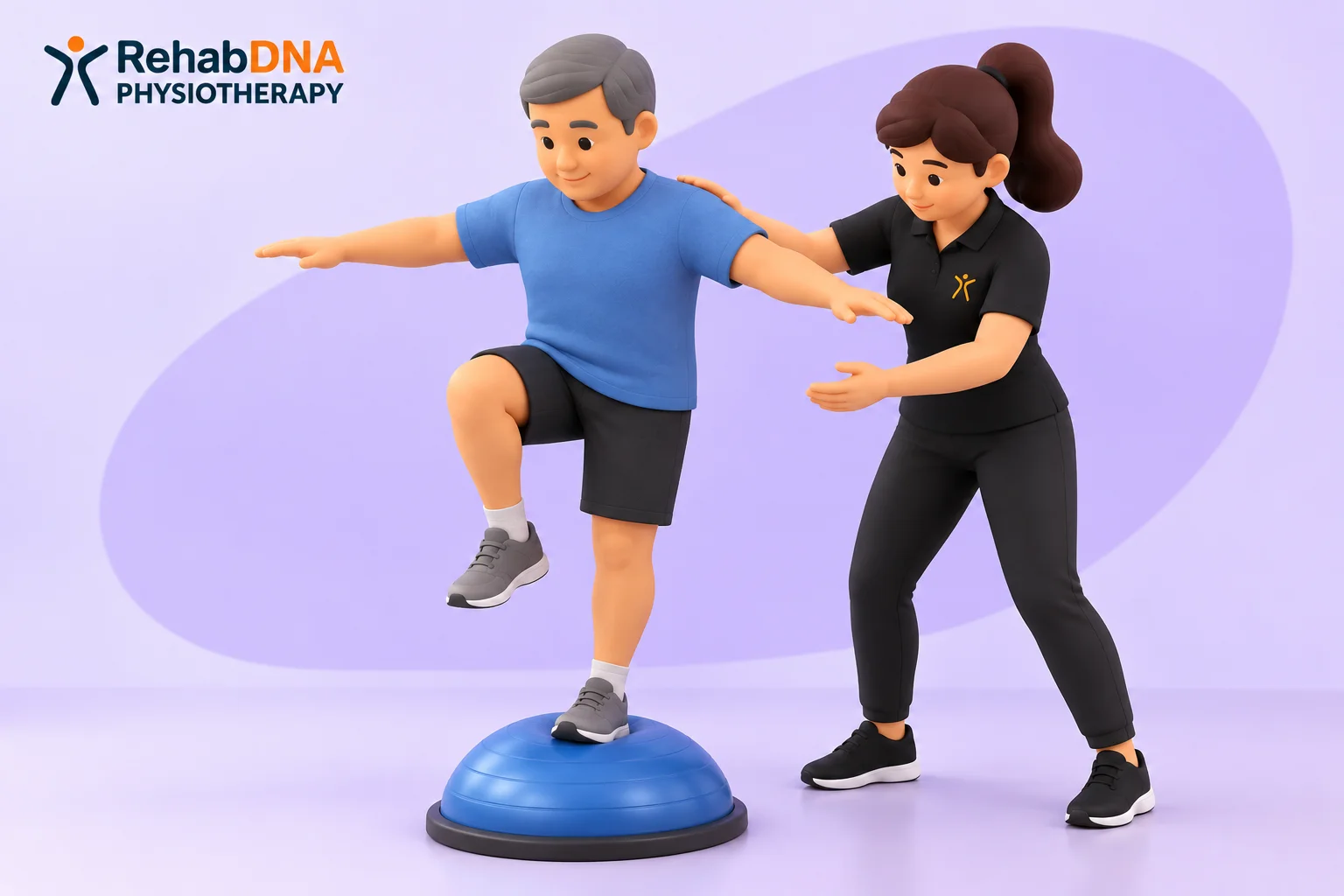
Effective balance training follows a few consistent principles regardless of who it’s for. It starts wherever your current ability actually is, not where you’d like it to be, and becomes progressively more challenging as you improve, rather than staying static. Progression typically moves through a few dimensions: narrowing your base of support, from feet apart to feet together to single-leg standing, changing the surface you’re standing on, from a firm floor to foam or an unstable cushion, reducing how much you rely on vision by closing your eyes, and eventually adding a second task, like catching a ball or answering a question while balancing, since real-world balance almost never happens with your full, undivided attention on just standing still.
That last piece, called dual-tasking, is genuinely important and often skipped in simpler programs. Research consistently shows that balance training using single, isolated tasks doesn’t reliably transfer to the divided-attention situations balance actually gets tested in day to day, like carrying a bag of groceries while stepping off a curb and checking for traffic at the same time. A program that only ever has you stand still and balance, without ever challenging you while your attention is elsewhere, is missing a real piece of what makes balance training effective.
Reactive balance training: a more advanced piece of the picture
Most traditional balance training is anticipatory, meaning you know what’s coming and have time to prepare for it, standing on one leg, walking heel to toe, holding a position on foam. That’s valuable, but it’s not the whole picture, because most real falls happen from an unexpected slip or trip, not from a predictable, anticipated challenge. Reactive balance training deliberately introduces controlled, sometimes unexpected disturbances, a gentle push or pull, a surface that shifts unexpectedly, to train your body’s automatic stepping and recovery response, the kind that actually catches you when you unexpectedly lose your footing. This is more specialized and is used selectively, particularly for people at higher fall risk or athletes needing to rebuild reactive stability after injury, but where appropriate it’s one of the more genuinely effective tools we have, with research showing meaningful reductions in fall rates for people who’ve gone through it.
A few exercises you can try at home
These are safe starting points for most people, though check with us first if you have a significant balance condition, osteoporosis, or a history of falls. Always have a stable chair or counter nearby for support if needed. Try standing on one leg for up to thirty seconds, holding onto something stable at first and working toward doing it unsupported, then eventually with your eyes closed. Practice a controlled weight shift, standing with your feet hip-width apart, shifting your weight fully onto one leg and lifting the other foot slightly off the ground, holding, then switching sides. And try walking heel to toe in a straight line, as though on a tightrope, keeping your gaze forward rather than looking down at your feet.
Related reading: Balance and Fall Prevention Physiotherapy | Vestibular Therapy in Newmarket | Return to Sport Physiotherapy | Physiotherapy for Osteoarthritis
Getting started Balance Training
Whether you’re concerned about a specific balance issue, recovering from an injury, or just want a program built around where you actually are right now, a proper assessment is the right place to start. You can book directly online, no referral required.

How is balance training different from general exercise?
General exercise like walking or strength training helps balance indirectly, but dedicated balance training specifically and progressively challenges the systems, vision, inner ear, and joint sensation, that your brain uses to keep you upright, in a structured way that general activity usually doesn’t.
Do I need to already have a balance problem to benefit?
No. Balance training is valuable proactively for athletes, older adults, and anyone recovering from an injury, not only for people who’ve already had a fall or noticeable balance issue.
What’s the difference between balance training and fall prevention for seniors?
They overlap significantly, but our fall prevention program is specifically built around the needs and goals of older adults. Balance training more broadly covers the same underlying principles applied to a wider range of people, including athletes and people with neurological conditions.
How often should I do balance exercises?
Research on structured programs generally supports at least two to three sessions a week for meaningful improvement, with programs commonly running around twelve weeks. Your specific plan will depend on your starting point and goals.
Is balance training safe if I’m unsteady on my feet?
Yes, when it’s properly supervised and appropriately dosed to your current ability. Exercises always start at a safe, achievable level and progress gradually, with support available as needed, rather than immediately challenging you beyond what’s safe.