Cupping Therapy in Newmarket
Cupping Therapy in Newmarket
Most people's first question about cupping isn't really about the treatment, it's about the marks. If you've seen an athlete with round purple circles on their back or shoulders, that's cupping, and it tends to generate as much curiosity as it does skepticism. We think both reactions are fair, and we'd rather explain plainly what it is, what it's likely doing, and what it isn't, than oversell it.
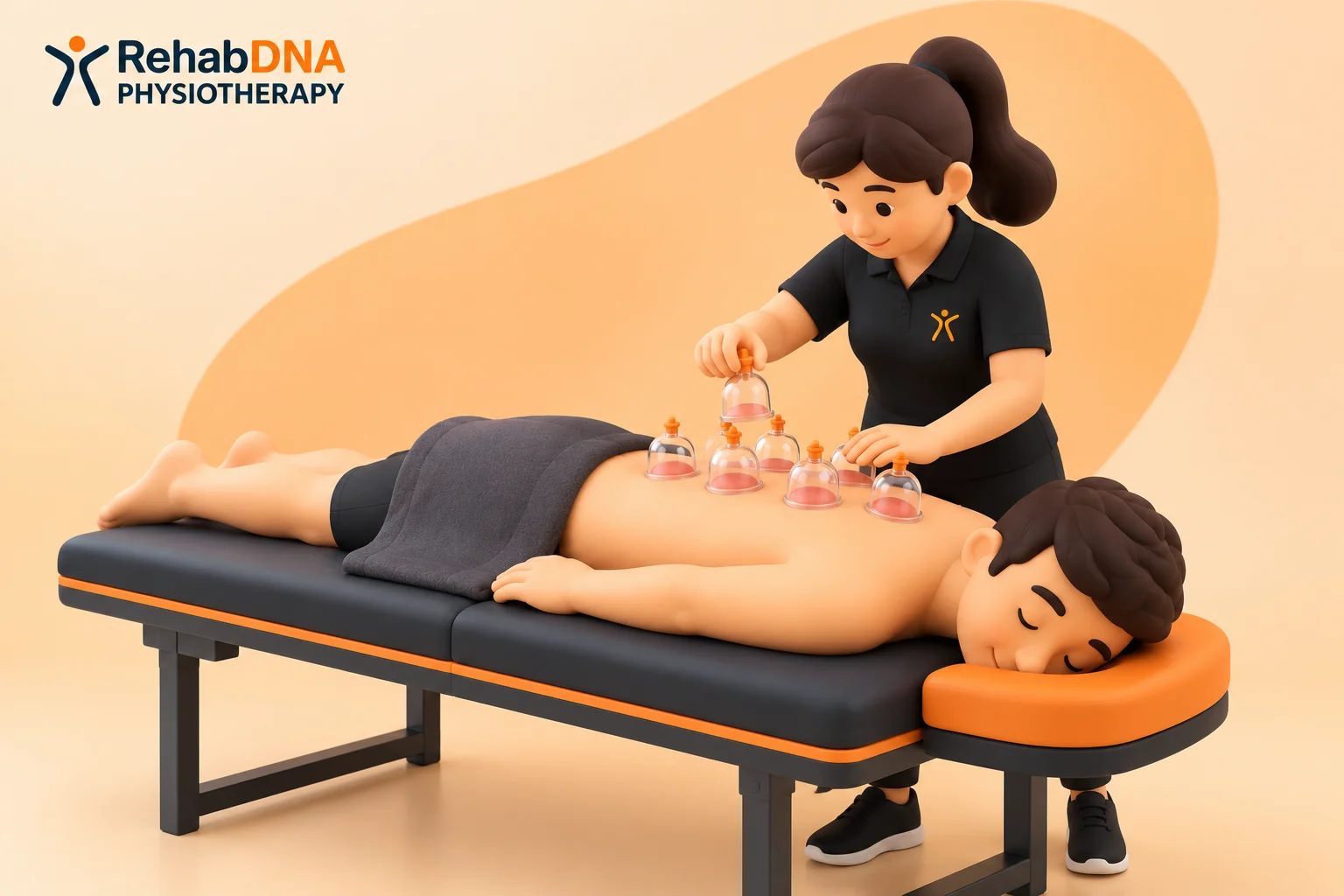
At RehabDNA, we use dry cupping, which doesn't involve any cutting or drawing blood, that's a different, more invasive practice with its own training and safety protocols that sits outside what we offer here. Dry cupping uses suction alone, either through a heated cup or a modern pump device, to draw the skin and underlying tissue upward into the cup.
What’s actually happening under the cup
The suction pulls blood toward the surface and causes small blood vessels just under the skin to rupture, which is what creates the circular red or purple marks people associate with cupping. These marks aren’t bruises in the sense of an impact injury, but they are a form of localized bleeding under the skin, and they typically fade over one to ten days depending on how much suction was used and your individual skin.
A common claim around cupping is that it “removes toxins” from the body. We want to be straightforward here: there isn’t good evidence to support that specific claim, and the marks left behind are simply from the ruptured capillaries, not evidence of anything being extracted from deeper tissue. What cupping more plausibly does, based on the more grounded theories, is stimulate blood flow to the area, engage the same kind of nerve-based pain gating mechanism that’s thought to explain some of the pain relief from massage and acupuncture, and mechanically help loosen tight, restricted soft tissue in a way that complements manual therapy.
Being honest about the evidence
Cupping’s research base is genuinely mixed, and it’s worth saying so plainly rather than overselling it. There’s some reasonably encouraging evidence for chronic low back pain, neck pain, and knee osteoarthritis pain, with several trials showing meaningful short-term improvement, particularly when cupping is combined with other treatment rather than used alone. That said, a lot of the underlying research has real quality problems, small sample sizes, inconsistent methods, and difficulty designing a convincing placebo comparison, since it’s hard to fake the sensation of suction convincingly. Reviewing bodies that specifically evaluate evidence quality, including major health research organizations, have consistently noted that the science supporting cupping is not yet strong for most of the conditions it’s used for, even where individual studies look promising. We treat cupping as a reasonable complementary option worth trying alongside your main treatment plan, not as a primary, stand-alone therapy, and not as something with a guaranteed effect.
What we typically use it for
In our clinic, cupping most often comes up as an adjunct for chronic muscle tension through the back, neck, and shoulders, myofascial trigger points that haven’t fully responded to massage alone, and general tightness that’s limiting how well someone can engage with their exercise-based physiotherapy program. It’s genuinely more useful as a complement to that broader plan than as something we’d reach for on its own.
Related reading: Massage Therapy in Newmarket | Neck Pain and Headache Physiotherapy | Physiotherapy for Sciatica
What a session actually involves
Cups, usually plastic or silicone, are applied to the skin over the treatment area, most commonly the back, shoulders, or neck, and left in place for roughly five to ten minutes while you rest. Some sessions use a moving or gliding technique instead, where oil is applied to the skin first and the cups are slid around the area in a way that resembles a deep, suction-based massage rather than a static application. Most people describe the sensation as a tight, pulling pressure rather than pain, and it’s generally well tolerated. You’ll likely notice the circular marks afterward, and mild soreness at the treatment site for a day or two is normal.
Who shouldn’t have cupping
Cupping isn’t appropriate for everyone, and this is worth taking seriously rather than treating as a formality. It’s generally avoided during pregnancy, in anyone with a pacemaker or other implanted electronic device, and in people with bleeding disorders or who are on blood-thinning medication, since the treatment deliberately ruptures small blood vessels. It’s also avoided over active skin conditions like eczema or psoriasis, since it can worsen these, and it’s not appropriate for anyone with significant cardiovascular disease, active cancer, or a known blood clot such as deep vein thrombosis. We’ll always ask about these before your first session, and if anything about your health history suggests cupping isn’t the right fit, we’ll say so directly rather than proceeding anyway.
Getting started Balance Training
If you’re dealing with muscle tension, back or neck tightness, or trigger points that haven’t fully resolved with massage alone, cupping is worth raising as a potential addition to your plan. It works best as a complement to manual therapy and exercise-based treatment, not as a substitute for either, and we’ll talk through whether it’s a sensible fit for your specific situation at your assessment.

Does cupping actually remove toxins from the body?
There isn’t good evidence to support this specific claim. The marks left by cupping come from small ruptured blood vessels under the skin, not from anything being extracted from deeper tissue. The more plausible benefits relate to increased local blood flow and pain modulation, not detoxification.
Does cupping hurt?
Most people describe it as a tight, pulling sensation rather than pain. It’s generally well tolerated, though the area may feel a bit sore for a day or two afterward, similar to how a deep massage can leave you feeling.
How long do cupping marks last?
Typically one to ten days, depending on how much suction was used and your individual skin. The marks fade in color from dark red or purple to lighter shades as they heal, similar to a bruise.
Is cupping backed by strong scientific evidence?
The evidence is genuinely mixed. There’s some encouraging research for chronic back pain, neck pain, and knee osteoarthritis, but much of the underlying research has quality limitations, and major research bodies have noted the evidence isn’t yet strong for most conditions cupping is used for. We treat it as a reasonable complementary option, not a primary treatment on its own.
Can anyone get cupping therapy?
No. It’s generally avoided during pregnancy, in people with pacemakers, bleeding disorders, or on blood-thinning medication, and in those with certain skin conditions, active cancer, significant cardiovascular disease, or a history of blood clots. We’ll review your health history before your first session to confirm it’s appropriate for you.